Tuesday, 11 April 2023

 All employees get a tax exemption of Rs 50 thousand U/s 16(ia) in any tax regime.| If you are also a

 taxpayer, then this information will be very useful to you. As everyone knows, this time the

 government gave a big relief to the taxpayer in the budget. The government announced that those

 earning less than Rs 7 lakhs will not have to pay income tax. However, this benefit will only be

 available to those who opt for the new tax regime. The Finance Minister has increased the income tax

 exemption limit to Rs 7 lakh in the new tax regime, which was earlier Rs 5 lakh. While under the

 previous tax regime, income up to Rs 2.5 lakh was tax-free.

You may also like- Master of Form 16 PartB in Excel for the Financial Year 2022-23 and Assessment Year 2023-24[This Excel Utility can prepare at a time 50 Employees form 16 Part B]


However, under the old tax regime, there is a provision for several standard deductions and exemptions on certain items. These benefits were not provided under the new tax regime. But let us tell you that this time the standard deduction has also been included in the new tax system. That is, regardless of the new or old tax regime, all taxpayers can benefit from the Rs 50,000 tax credit.

He gets a tax exemption of 50 thousand


Explain that a taxpayer can claim up to Rs 50,000 for a standard deduction whereas any employee with an income of Rs 15.5 lakh or more will get a benefit of Rs 52,500 as a standard deduction. Under the new tax regime,

You may also like- Master of Form 16 Part A&B in Excel for the Financial Year 2022-23 and Assessment Year 2023-24[This Excel Utility can prepare at a time 50 Employees form 16 Part A&B]


What is the standard deduction?


The standard deduction was introduced in the budget for the year 2018. Earlier, the limit was Rs 40,000 which was increased to Rs 50,000 the following year. The purpose of this is to maximize income to employees by giving them tax exemption. The standard deduction is a deduction taken from an income taxpayer’s income and then tax is calculated on the remaining income.


Employees and retirees are already being given the opportunity to enjoy tax exemption through standard deductions. Suppose the annual income of an employed person is Rs 8 lakh. In such a situation, if a standard deduction benefit up to Rs 50,000 is available in the total package, their tax will be calculated at Rs 7,50,000 instead of Rs 8 lakh.
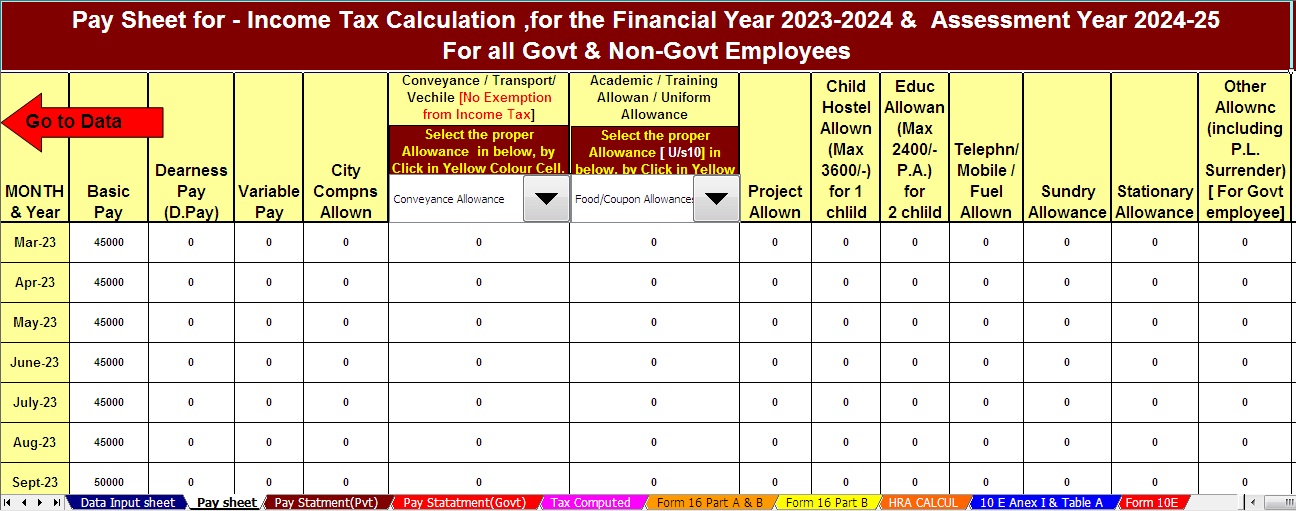
Download Automated Income Tax Preparation Excel-Based Software All in One for the Government & Non-Government (Private) Employees for the F.Y.2023-24 and A.Y.2024-25

All employees get a tax exemption of Rs 50 thousand U/s 16(ia) in any tax regime.

All employees get a tax exemption of Rs 50 thousand U/s 16(ia) in any tax regime.

All employees get a tax exemption of Rs 50 thousand U/s 16(ia) in any tax regime.

Feature of this Excel Utility:-


1) This Excel utility prepares and calculates your income tax as per the New Section 115 BAC (New and Old Tax Regime)


2) This Excel Utility has an option where you can choose your option as a New or Old Tax Regime


3) This Excel Utility has a unique Salary Structure for Government and Non-Government Employees Salary Structure.


4) Automated Income Tax Arrears Relief Calculator U/s 89(1) with Form 10E from the F.Y.2000-01 to F.Y.2023-24 (Update Version)


5) Automated Income Tax Revised Form 16 Part A&B for the F.Y.2023-24


6) Automated Income Tax Revised Form 16 Part B for the F.Y.2023-24


Read More

Monday, 10 April 2023

  Which is better- the old or the new tax regime? The Budget 2023 for the current financial year brought

 a major change for the assessee by introducing the new tax regime as voluntary compliance for all

 taxpayers.

 Although a private individual can choose to switch to the old tax regime if he/she wishes. There are

 advantages and disadvantages to both the old tax regime and the new tax regime, but it can be

 confusing for taxpayers to choose the most appropriate regime for themselves. Let us examine the

 various aspects to be considered in the old tax regime and the new tax regime in F.Y 2023-24.

You may also like- At a time 50 Employees Auto Calculate and automatic Preparation Income Tax Form 16 Part B for the Financial Year 2022-23 and Assessment Year 2023-24

Under the new tax regime


The new tax regime has increased the range of tax rates from 0% to 30% with a minimum exemption of up to Rs 3 lakhs and a maximum tax rate of 30% applicable from Rs.15 lakhs. The new income tax rates are listed below:


INCOME TAX SLAB RATES IN THE NEW TAX REGIME 2023-24

ANNUAL INCOME

NEW TAX REGIME

0-3 Lakhs

Nil

3-6 Lakhs

5%

6-9 Lakhs

10%

9-12 Lakhs

15%

12-15 Lakhs

20%

Above 15 Lakhs

30%


Highlights of the New Tax Regime 2023-24


1. The new tax regime is voluntary compliance for the year 2023-24.

2. A person earning Rs. 7 without annual entitlement to abatement.

3. Higher rate of surcharge on income above Rs. 5 crores reduced from 37% to 25%.

4. In order to simplify complicated paperwork and reduce the burden of compliance and administration on the taxpayer and tax authorities regarding tax deductions and exemptions, fewer deductions were made.

5. Some tax deductions not allowed under the new tax regime are available

A. Waiver of Travel Allowance

B. Rental Assistance

C. Educational Assistance for Children

D. Exemption for employment taxes

E. Interest on home loans

F. Deduction for specified

6. No stringent rules and regulations for your investments under the new tax regime.

You may also like- At a time 50 Employees Auto Calculate and automatic Preparation Income Tax Form 16 Part A&B for the Financial Year 2022-23 and Assessment Year 2023-24

 Comparison between the old tax regime and new tax regime

As announced in the 2023-24 investment budget, the new tax regime has been imposed by default, but still an individual can choose between the old tax regime and the new tax regime if he/she wishes. If you want to claim deductions and exemptions, the old tax regime is more favorable, otherwise, the new tax regime has multiple levels of income brackets and rates.


The key point to understand here is which tax regime allows you to take home more money.


Let us take an example to understand the situation in both lights, Mr. Suresh earns Rs. 50,00,000 per annum. He is claiming a deduction under section 80C against LIC and EPF for Rs. 1,50,0 He has taken out health insurance for which he pays a premium of Rs 25,000 which he claims as tax deductible under section 80 D. He also claims a tax-free traveling allowance of Rs.38,000 and rent allowance of Rs. 1,60,0 Let’s calculate the tax due in both cases.


Understand with the help of illustration 1 of New and old tax regimes for taxpayers:-

Illustration

Old Tax Regime

New Tax Regime

Income From Salary

50,00,000

50,00,000

Less:- Exemptions
House Rent Allowance
Leave Travel Allowance

(1,60,000)
(38,000)

Not Allowed
Not Allowed

Gross Total Income

48,02,000

50,00,000

Less:- Standard Deduction

(50,000)

(50,000)

Less Deduction U/s Chapter VI-A
(EPF +LIC+ Tuition Fees, etc)

(1,50,000)

Not Allowed

Less:- Deduction U/s 80D
If Senior Citizen -Rs 50000 otherwise Rs.
25000 Maximum Allowed.

(25,000)

Not Allowed

Less:- Other Deduction If any

Allowed

Not Allowed

Net Taxable Income

45,77,000

49,50,000


Note: - Assume that the taxpayer is less than 60 years of age.


B. Total taxes payable under the new and old tax regimes


Tax Calculation Slab

Old Tax Regime Rates

Tax (Old) Amount

Tax Calculation Slab

New Tax Regime Rates

Tax (New) Amount

0 – 2,50,000

0%

Nil

0 – 3,00,000

Nil

Nil

2,50,000 - 5,00,000

5%

12,500

3,00,000 - 6,00,000

5%

15,000

5,00,000 -10,00,000

20%

1,00,000

6,00,000 - 9,00,000

10%

30,000

Above 10,00,000

30%

10,73,100

9,00,000 - 12,00,000

15%

45,000


12,00,000-15,00,000

20%

60,000


Above 15,00,000

30%

10,35,000

Total Tax


11,85,600

Total Tax


11,85,000

Add: Higher Education Cess @4%


47,424

Add: Higher Education Cess @4%


47,400

Total Tax payable


12,33,024

Total Tax payable


12,32,400


As the example above shows, people take home more money under the new tax system, but the situation will be different if the amount of additional payments and deductions are higher. It is therefore advisable to calculate your tax due under both regimes. 

Download Automated Income Tax Preparation Excel-Based Software All in One for the Government & Non-Government (Private) Employees for the F.Y.2022-23 and A.Y.2023-24

Which is better- the old or new tax regime?
 
Which is better- the old or new tax regime?

Which is better- the old or new tax regime?

Which is better- the old or new tax regime?

Feature of this Excel Utility:-


1) This Excel utility prepares and calculates your income tax as per the New Section 115 BAC (New and Old Tax Regime)


2) This Excel Utility has an option where you can choose your option as a New or Old Tax Regime


3) This Excel Utility has a unique Salary Structure for Non-Government Employees Salary Structure.


4) Automated Income Tax Form 12 BA


5) Automated Income Tax Revised Form 16 Part A&B for the F.Y.2023-24


6) Automated Income Tax Revised Form 16 Part B for the F.Y.2023-24

7) Automated House Rent Exemption Calculation U/s 10(13A)

Read More

Friday, 7 April 2023

Budget 2023- Key points of taxation- Old vs. New tax regime | The Union budget for 2023 was

 presented in Parliament today, on February 1, 2023, the Finance Minister proposed five important

 announcements for taxpayers: 

1. Zero taxes, up to Rs of income. 7 lakhs (after U/S 87A discount)

2. Six rental plates and new tax rates

3. Standard deduction of Rs. 52,500/- for salary earners of Rs. 15.5 lakhs or more.

4. Surcharge on Income greater than 2 Cr 25% instead of 37%

5. The discount for paid leave of up to 10 months of average salary, at the time of retirement in the case of an employee (who is not an employee of the Central Government or the State Government), is exempt in accordance with subsection (ii) of clause (10AA) of article 10 of the Income Tax Law in the notified measure.


Note: ALL THE PREVIOUS CHANGES (Sr. 1 TO Sr.4) ONLY APPLY TO THE NEW INCOME TAX REGIME, THERE ARE NO CHANGES TO THE OLD INCOME TAX REGIME. This means that you can benefit from the above changes if you select the new tax regime. Zero tax under the old tax regime, up to Rs. 5 lakhs (after U/S 87A discount).


Non-alteration of the table and rate of Income Tax in the old tax regime. No change in the standard deduction for a salaried person with an income of Rs. 15.5 lakhs or more if you select the old tax regime.


Some more important changes: the standard deduction of Rs.50,000/- for salaried persons, and the family pension deduction of up to Rs.15,000/- is currently only allowed under the old regime.


New personal income tax regime as a standard tax regime. However, citizens will continue to have the option of benefiting from the old tax regime.


New Tax Regime as an alternative to the Old Tax Regime for Individuals and HUFs. Since the Old Tax Regime is optional by all means, the taxpayer now has the option to choose between the New and the Old Tax Regime after a careful comparison supported by facts and figures.


Income tax rates in the new tax regime and in the old tax regime: 

Budget 2023- Key points of taxation- Old vs. New tax regime


The above table clearly shows that the new tax regime has proposed lower tax rates, for income segments up to Rs 15 lakh, but you should remember that the proposed lower tax rates will apply only if you are willing to forgo exemptions and deductions. provided. in various provisions of the Income Tax Law of 1961. This means that, by opting for the New Tax Regime, you must waive some exemptions and deductions provided for in Chapter VI A of the Law that grants deductions under art. . 80. Even the deduction of interest on the mortgage loan, under the terms of art. 24(b) will be rejected.

Some of the deductions and exemptions that you will not have in the new regime


The Ministry of Finance expects that four out of five Income Tax payers will switch to the new tax regime. It analyzed the income and investment data of 57.8 million taxpayers and found that 69% would prefer to save on taxes under the new system.


Another 20% may want to switch to avoid the hassle and red tape involved in tax planning. A taxpayer who takes various exemptions and deductions, such as the housing allowance and Section 80C deductions, will not be able to benefit from the change to the new system.


The taxpayer may make the choice based on his economic situation and what is most appropriate from the point of view of tax planning. The budget tried to put more money in the hands of taxpayers by reducing incentives to save. Section 80C forces people to save, and they will be withdrawn from saving if there is no tax incentive.


The momentum appears to be geared towards spending rather than focusing on long-term financial security for taxpayers. A taxpayer who opts for the new tax regime and forgoes tax breaks may end up spending money instead of using it for financial security.


He doesn't really need to do an elaborate calculation to know which regimen to choose. The answer is quite yes.


Anyone who claims tax exemptions and deductions is more than ceded under the old and new tax regime

Download Automated Income Tax Preparation Excel-Based Software All in One for the Government & Non-Government (Private) Employees for the F.Y.2023-24 and A.Y.2024-25 

Budget 2023- Key points of taxation- Old vs. New tax regime

Budget 2023- Key points of taxation- Old vs. New tax regime

Budget 2023- Key points of taxation- Old vs. New tax regime

Feature of this Excel Utility:-


1) This Excel utility prepares and calculates your income tax as per the New Section 115 BAC (New and Old Tax Regime)


2) This Excel Utility has an option where you can choose your option as a New or Old Tax Regime


3) This Excel Utility has a unique Salary Structure for Government and Non-Government Employees Salary Structure.


4) Automated Income Tax Arrears Relief Calculator U/s 89(1) with Form 10E from the F.Y.2000-01 to F.Y.2023-24 (Update Version)


5) Automated Income Tax Revised Form 16 Part A&B for the F.Y.2023-24


6) Automated Income Tax Revised Form 16 Part B for the F.Y.2023-24


Read More

Thursday, 6 April 2023

  Section 16 of the Income Tax Act| Section 16 deductions help revise your taxable income to reduce

 your tax liability.


Standard deduction 

Deduction from entertainment allowance paid by your employer

Deduction at the professional rate from salary income

The standard deduction under Section 16(ia) – Under Section 16(ia), the standard deduction is the fixed deduction allowed from your salary income. It replaced transport allowance and medical treatment deductibles and was introduced by the Government in the Union Budget 2018. The amount of standard deduction allowed was Rs.50,000. You can deduct this amount from your wage income for taxable income.

You may also like: - Prepare at a 50 Employees Form 16 Part B for the Financial Year 2022-23 and Assessment Year2023-24(This Excel Utility can prepare at a time 50 Employees Form 16 Part B)

In the 2019 interim budget, the standard deduction threshold has been raised to Rs.50,000 to provide better tax relief. Thus, from the tax year 2021-22 and subsequent years, the standard deduction is capped at Rs.50,000 until there is a change. The standard deduction will apply if you choose the new scheme slab rates as set out in Budget 2023.


The standard deduction under Section 16(ia) also applies to retirees with retirement income. Since the pension is taxable under the head – Salary Income, a standard deduction of Rs.50,000 from this pension is allowed in any financial year.


However, if the salary income is less than Rs.50,000, the normal deduction allowed is equal to the salary income. Therefore, the standard deduction is Rs.50,000 or salary income, whichever is lower. It is important to note that the ordinary tax exemption does not affect or conflict with other tax exemption provisions under the Income Tax Act. 1961

You may also like: - Prepare at a 50 Employees Form 16 Part A&B for the Financial Year 2022-23 and Assessment Year 2023-24(This Excel Utility can prepare at a time 50 Employees Form 16 Part A&B) 

Illustration of standard deduction calculation:


Other Taxable Deductions – Rs. 50,000

Gross salary - Rs 6,50,000

Standard deduction – Rs 50,000

Total Cost - Rs 6,00,000

Other Deductions – Rs 1,50,000

Taxable income - Rs 4,50,000

2. Deduction of entertainment allowance Under Section 16(ii) – If your employer provides entertainment allowance, it will be included in your gross pay and will be added to your wage income. However, the Section 16(ii) deduction allows you to claim the same gaming tax deduction.

And the amount you deduct depends on the nature of your project.

If you are a government servant belonging to the Central or State Government, the deduction of entertainment subsidy under Section 16(ii) is the lowest of the following:

Rs. 5,000

20% of the basic salary

A true entertainment subsidy is obtained

It’s a deduction allowed when your pay doesn’t include any other allowances, benefits, or privileges offered by your employer. Also, it treats income as an entertainment subsidy and not spending on entertainment.

You may also like: - Prepare at a 100 Employees Form 16 Part B for the Financial Year 2022-23 and Assessment Year 2023-24(This Excel Utility can prepare at a time 100 Employees Form 16 Part B) 

2. If you are not a government employee, there is no deduction allowed on entertainment allowance related to your salary income. So if your employer gives you an entertainment allowance, it will be added to your taxable income.


Example of calculating the entertainment subsidy deduction:


Salary excluding allowances, benefits, and bonus - Rs 4,00,000

Monthly entertainment allowance – Rs 3000

Entertainment allowance for the year – Rs 36000

Deductible:

Rs. 5,000

20% of salary – Rs 80,000

Actual value – Rs 36,000

The smallest of the above items is Rs.5,000. So the allowable deduction on entertainment allowance is Rs 5,000. 

3. Business tax deduction under Section 16(iii) – Business tax applies to your salary income and becomes part of your tax liability. However, Section 16(iii) of the Income Tax Act, 1961 provides for tax deduction subject to the following conditions:

You may also like: - Prepare at a 100 Employees Form 16 Part A&B for the Financial Year 2022-23 and Assessment Year 2023-24(This Excel Utility can prepare at a time 100 Employees Form 16 Part A&B)

 The deduction is taken from the salary income of the year you paid professional tax.

If your employer pays employment taxes, it will be part of the prerequisites when calculating gross pay. You can then claim the business tax paid by your employer under Section 16(iii) of the Income Tax Act, 1961.


There is no defined limit on service tax deductions. As a result, the amount of business tax you pay will be fully deductible, regardless of the amount.

If you are liable for a penalty or business tax interest, that amount is not eligible for deduction.


Conclusion

As a responsible taxpayer, you need to be aware of the tax implications of your salary income in order to make the most of your benefits. Section of 16 of the Income Tax Act 1961 provides for customary deductions and other exemptions from gaming royalties and business taxes. However, certain factors must be considered in particular in determining the applicability of a specific tax rule.

Download Auto Calculate And Auto Preparation Excel BasedSoftware All in One for the Non-Govt Employees for the Financial Year 2023-24 and Assessment Year 2024-25 as per Budget 2023

Section 16 of the Income Tax Act

Section 16 of the Income Tax Act

Form 12 BA

The Main Feature of this Excel Utility is:-

+This Excel Utility can prepare at a time Tax Computed sheet

+ Auto Calculate H.R.A. Exemption U/s 10(13A)

+ Inbuilt Salary Structure as per the Non-Govt Employee's Salary Structure

+ Auto Calculate Form 12 BA

+ Automated Form 16 Part A&B and Form 16 Part B)


Read More

Wednesday, 5 April 2023

  New and Old Tax Regime U/s 115 BAC

Old versus new tax scheme according to relevant 2023 Budget| The Minister of Finance has announced a new tax regime in the 2020 budget, including additional tax brackets and lower tax rates. Many taxpayers had long requested it, but it came with the condition that all deductions and exemptions are allowed under the old tax system would be revoked. Moreover, the tax component applicable to the new regime has been changed in the 2023 budget, which is applicable from the financial year 2023-24 (the reference year 2024-25).

You may also like: - Auto Calculate Income Tax Form 16 Part A&B for the Financial Year 2022-23(This Excel Utility can prepare at a time 100 Employees Form 16 Part A&B in Excel)

To add to the confusion, the Treasury Secretary offered taxpayers a choice between the new tax regime and the old tax regime, leaving the choice up to the taxpayer. With all of these factors interacting, the tax code has become more complex than simple.


You ask yourself, "What would you choose - the new tax regime or the old tax regime?" This article can help you determine which tax system. Let’s look at tax brackets and tax rates, as well as the pros and cons of the two tax regimes. Followed by a comparison between the two. So, let’s get started.


New tax regime - More plates, lower tax rate, but no way to reduce taxes

There are two main differences between the new tax regime and the old tax regime.

First, under the new regime, the number of tax brackets has increased, along with a reduction in rates to sub-Rs. Range of 15 lacks.

You may also like: - Auto Calculate Income Tax Form 16 Part A&B for the Financial Year 2022-23(This Excel Utility can prepare at a time 50 Employees Form 16 Part A&B in Excel)


Second, taxpayers under the new regime will not be able to take advantage of the deductions and exemptions available under the existing tax regime.


The following is a comparison of the old tax rates and new tax rates: 

Tax Slab(Rs.)

Old Tax Rates

New Tax Rates (Old)

Tax Slab( Rs.))

New Tax Rates

0 – 2,50,000

0%

0%

0 – 3,00,000

0%

2,50,000 – 5,00,000

5%

5%

3,00,000 - 6,00,000

5%

5,00,000 – 7,50,000

20%

10%

6,00,000 – 9,00,000

10%

7,50,000 – 10,00,000

20%

15%

9,00,000 – 12,00,000

15%

10,00,000 – 12,50,000

30%

20%

12,00,000 – 15,00,000

20%

12,50,000 – 15,00,000

30%

25%

12,00,000 – 15,00,000

20%

Above Rs. 15,00,000

30%

30%

15,00,000 & above

30%


 The old tax regime is complex, to say the least. While taxes are high, there are many ways to lower your taxes.


The government has granted nearly 70 exemptions and deductions to Indian taxpayers over the years by adding sections to the Income Tax Act. This allows people to reduce their tax liability and pay fewer taxes.

While some exemptions, such as Housing Allowance (HRA) and Travel Allowance (LTA), are included in your pay, deductions allow you to reduce your tax liability by investing, saving, or spending money on goods/services of accuracy. Section 80C is one of the most popular and selected deductions, which allows you to reduce your taxable income by Rs 1,50,000.


Additionally, there are several categories that allow you to take advantage of deductions, for example, interest on your loans (both housing and education) or premiums paid for health insurance.


The followings are the most popular tax exemptions and deductions available to Indian taxpayers:


Exemptions

Deductions

House Rent Allowance

Public Provident Fund

Leave Travel Allowance

ELSS (Equity Linked Saving Scheme)

Mobile and Internet Reimbursement

Employee Provident Fund

Food Coupons or Vouchers

Life Insurance Premium

Company Leased Car

Principal and Interest component of Home Loan

Standard Deduction

Children Tuition Fees

Uniform Allowance

Health Insurance Premiums

Leave Encashment

Investment in NPS


Tuition fee for Children


Saving Account Interest


Your taxable income can be reduced by lakhs to include exemptions and deductions. However, it also means getting strategic each year to maximize your paycheck, investments, and/or savings to minimize your taxable income.

You may also like: - Auto Calculate Income Tax Form 16 Part B for the Financial Year 2022-23(This Excel Utility can prepare at a time 100 Employees Form 16 Part B in Excel)

Past income tax vs. old income tax. New tax regime: Which should you choose?

Because everyone is eligible for different deductions, sources, and amounts of income, the same rule may not apply to everyone. Thus, it becomes important for taxpayers to examine and understand the tax payable under both regimes before deciding which one to choose.


While the new system may look good at first because of the lower tax rates, this is not the case.


Because, with these changes, with the new tax regime, anyone earning Rs. 7.50 lakh will have to pay Rs. 25,000 in taxes. While those earning Rs. 10 faults save Rs. 37,500 with taxes.


Here’s what you need to do:

Step 1 – Calculate any tax exemptions (refunds) you can claim

Remaining in rent entitles you to HRA (Home Rent Allowance), the maximum payroll deduction. In addition, other tax-free components such as LTA (Leave Travel Allowance), Food bills, Telephone bills, etc. are also included

You may also like: - Auto Calculate Income Tax Form 16 Part B for the Financial Year 2022-23(This Excel Utility can prepare at a time 50 Employees Form 16 Part B in Excel)


The type used it. If you choose to move to the new tax regime, everything that is “untaxed” becomes “taxed”.


Step 2 - Calculate any tax deductions you are claiming

As a salaried person, you automatically take two deductions:

Standard deduction of Rs 50,000


The contribution to your Employees Provident Fund (EPF).


Even if you continue to contribute to the EPF, you will not be eligible for these deductions under the new tax regime. In addition, you can’t claim the deduction for your home loan (if you have one) or life insurance, or health insurance that previously helped you lower your taxable income.


Step 3 – Combine these tax exemptions and tax deductions and subtract them from your paycheck to get your taxable income.


Step 4 – Same as, calculating your taxable income if the deductions, as well as exemptions, were excluded.


These results can help you to decide which tax regime to opt for.

Here are two examples of tax liabilities with and without tax exemption and/or deductions under the old and new tax regimes for your convenience.


Annual Income

Old Tax Regime Rates

New Tax Regime Rates (old)

Annual Income

New Tax Regime Rates

Up to Rs. 2.5 lakhs

Exempt

Exempt

Up to Rs.  3 lakhs

NIL

Rs.  2.5 to 5 lakhs*

5%

5%

Rs.  3 to 6 lakhs

5%

Rs.  5 to 7.5 lakhs

20%

10%

Rs.  6 to 9 lakhs

10%

Rs.  7.5 to 10 lakhs

20%

15%

Rs. 9 to 12 lakhs

15%

Rs.  10 to 12.5 lakhs

30%

20%

Rs.  12 to 15 lakhs

20%

Rs.  12.5 to 15 lakhs

30%

25%

Rs.  12 to 15 lakhs

20%

Above Rs.15 lakhs

30%

30%

Rs. 15 lakhs and above

30%


Your taxable income can be reduced by lakhs to include exemptions and deductions. However, it also means that you need to find ways to maximize your paycheck, investments, and/or savings each year to keep your taxable income low.

You may also like: - Auto Calculate Income Tax Form 16 Part B for the Financial Year 2022-23(This Excel Utility can prepare at a time 100 Employees Form 16 Part B in Excel)


Past income tax vs. old income tax. New tax regime: Which should you choose?

Because everyone’s eligibility for deductions, sources, and amounts varies, the same rule may not apply to everyone. Thus, it becomes important for taxpayers to examine and understand the tax payable under both regimes before deciding which one to choose.


While, at first glance, it appears that the new system is better for lower taxes, this is not the case.


With these changes, as per the new tax regime, who's earning between Rs. 7.50 lakh will pay Rs. 25,000 in taxes. While those earning Rs. 10 lacks will save Rs. 37,500 with taxes.

You may also like: - Auto Calculate Income Tax Form 16 Part A&B and Part B for the Financial Year 2022-23(This Excel Utility can prepare One by One Form 16 Part A&B and Part B in Excel)


Contribution to  Employees Provident Fund (EPF).


Even if you continue to contribute to the EPF, you will not be eligible for these deductions under the new tax regime. Also, you won’t be able to claim deductions for your home loan (if you have one) or life insurance policies, or health insurance policies that previously helped you reduce your taxable income.


Step 3 – Combine these tax exemptions and tax deductions and subtract them from your paycheck to get your taxable income.


Step 4 – Same as, calculating your taxable income if these deductions as well as exemptions were excluded.


The results can help you to decide which one is the tax regime to opt for.

Here are two examples of tax liabilities with and without tax exemption and/or deductions under the old and new tax regimes for your convenience.


The Income Tax Section 87A provides a tax refund to taxpayers if their total income is not more  than Rs 5 lakh after deducting  deductions 80C to 80U


Example 1 - Taxpayer with Income of Rs.12.5 lakhs

According to the tax slabs given above, the rate of the old tax regime is 30% and the rate of the new tax regime is 25% for a salary income of 12.5 lakhs. Let us now calculate the total tax due after taking the deductions allowed under the old tax regime.


Particulars

Old Tax Regime

New Tax Regime (Old)

New Tax Regime

Annual Income

12,50,000

12,50,000

12,50,000

Taxable Income

12,50,000

12,50,000

12,50,000

Less- Standard Deduction

50,000

-

50,000

Less- Deductions U/s 80C

1,50,000

-

-

Less- Deductions U/s 80D*

75,000*

-

-

Taxable Income

9,75,000

12,50,000

12,00,000

Total Tax Payable

1,11,800( Approx)

1,30,000

93,600


(*) assuming for themselves and their dependent parents are senior citizens Rs 25,000 and Rs 50,000 respectively.


If you opt for the old tax regime instead of the new one, you would save another Rs 8,000 in taxes.

Apart from the above deductions, HRA, and other deductions can also be claimed under the old regime.


Example 2 - Taxpayer with Net Income of Rs. 8 lakhs from Salary


Particulars

Old Tax Regime

New Tax Regime (Old)

New Tax Regime

Annual Income

8,00,000

8,00,000

8,00,000

Taxable Income

8,00,000

8,00,000

8,00,000

Less- Standarad Deduction

50,000

-

50,000

Less- Deductions U/s 80C

1,50,000

-

-

Less- Deductions U/s 80D*

50,000

-

-

HRA/LTA & Other

50,000

-

-

Taxable Income

5,00,000

8,00,000

7,50,000

Total Tax Payable

0

46,800

31,200


The important thing


Same the new and the old income tax slab have their advantages and disadvantages. Whether you choose the new or old tax regime there should be certainly a doubt in mind - whether you should save and use life insurance or not.


The goals of buying and saving/ investing in life insurance should be to achieve your life goals and protect your family’s future, not just to take advantage of tax benefits.

Download Auto Calculate Income Tax Arrears Relief Calculator U/s 89(1)with Form 10E From the F.Y.2000-01 to F.Y.2023-24(Updated Version)

Old versus new tax scheme according to relevant 2023 Budget
 
Old versus new tax scheme according to relevant 2023 Budget

Old versus new tax scheme according to relevant 2023 Budget

Read More

Total Pageviews
